Businesses Don't Need Another AI Tool. They Need a Better Way to Work.
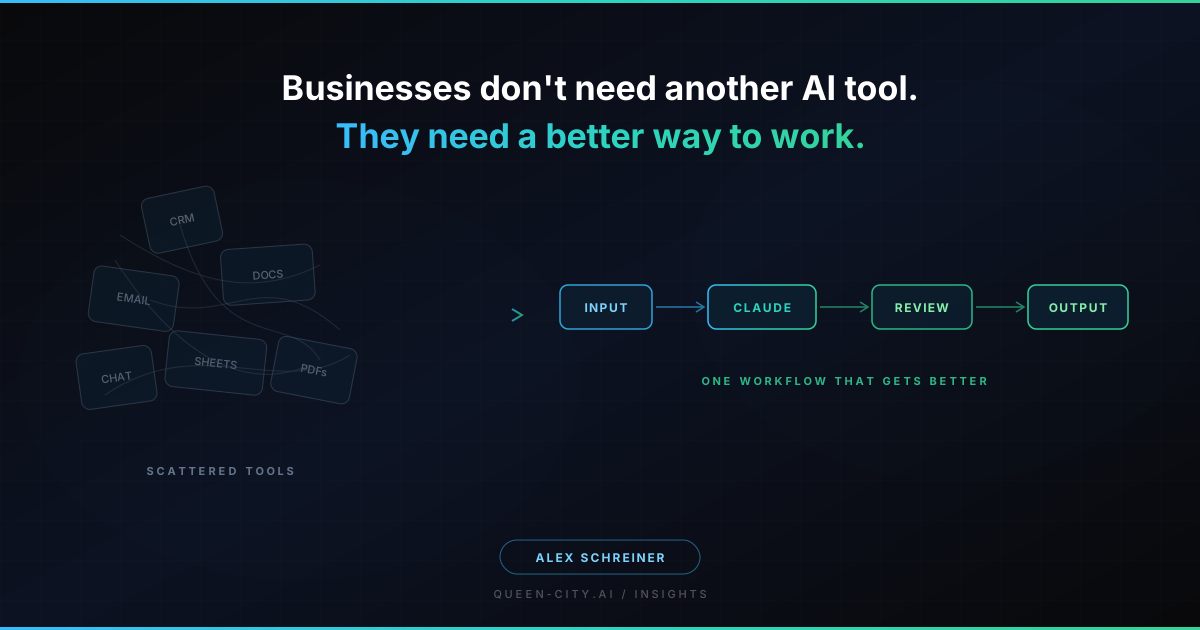
Most companies do not need a sweeping AI strategy to begin. They need one workflow that gets better. Here is how to find it, and where Claude actually fits.

Alex Schreiner
Head of Growth
A lot of business leaders are starting from the same place with AI.
They know tools like Claude are powerful. They have seen the demos. They have probably tried asking it to write an email, summarize a document, or help think through a problem. The first reaction is usually some version of, "This is impressive."
But then comes the harder question.
Now what?
That is where a lot of companies get stuck. Not because they are behind. Not because they do not understand technology. They get stuck because the conversation around AI often jumps too quickly from curiosity to transformation. It makes it feel like the business needs a massive strategy, a complete systems overhaul, or a fully automated future before it can begin.
Most companies do not need to start there.
They need to start with the work.
Start with the work, not the strategy
Claude is one of the more capable AI tools available today, especially when it comes to reading, writing, summarizing, reasoning through complex information, and helping people move from a messy starting point to a more useful first draft or next step. That makes it especially interesting for businesses, because so much of modern work is not one clean task. It is scattered across emails, meeting notes, documents, spreadsheets, customer requests, internal updates, and decisions that live in people's heads.
The real opportunity is not simply giving everyone access to Claude and hoping they find ways to use it. Some will. Most will not. And even the people who use it well may end up creating personal productivity gains that never turn into company-wide improvement.
The better opportunity is to ask where Claude can fit into the way the business already works.
Look for friction, not science fiction
For most organizations, that starts with a simple observation. There are usually a handful of workflows that everyone knows are more manual than they should be. A sales team spends too much time turning call notes into follow-ups. An operations team is constantly copying information from one system into another. A client service team is rewriting the same types of updates over and over again. A leadership team is trying to make decisions from information that is spread across too many places.
None of these examples sound futuristic. That is exactly the point.
The best AI use cases usually do not start as science fiction. They start as friction.
This is where Claude can be genuinely useful. It can help summarize information, draft communications, compare documents, structure messy inputs, support research, and help teams get to a stronger starting point faster. In technical teams, Claude can also support developers by helping them understand code, troubleshoot issues, generate documentation, and accelerate repetitive engineering tasks.
But the value does not come from the tool alone. It comes from placing the tool inside a clear process.
"Using AI" is not the same as workflow improvement
That distinction matters.
A company can say, "We are using Claude," and still not change much about how work gets done. Someone may use it to draft a better email. Someone else may use it to summarize a report. Those are helpful moments, but they are not the same as workflow improvement.
Workflow improvement happens when the company can point to a process and say, "This used to take three hours, and now it takes thirty minutes." Or, "This used to depend on one person knowing where everything was, and now the team has a repeatable way to get the answer." Or, "This used to create errors because information was being manually retyped, and now we have a cleaner review step before anything moves forward."
That is when AI becomes measurable.
It is also why businesses should be careful about starting with too broad of an AI agenda. When the goal is "use AI," the results are vague. When the goal is "reduce time spent preparing client recaps by 50%," the work becomes much easier to define, build, and measure.
A practical Claude integration should begin with one business workflow, not fifty. It should have a clear owner, a clear input, a clear output, and a clear review step. The team should know what Claude is helping with, what it is not allowed to do, and where human judgment still matters.
Guardrails are what make adoption sustainable
That last part is important.
Claude can be powerful, but businesses still need guardrails. This is especially true when AI is connected to internal documents, customer data, operational systems, or external tools. The goal is not to let AI roam freely through the company. The goal is to give it the right context, the right permissions, and the right boundaries so it can support the people doing the work.
That is usually where the conversation becomes less about "AI" and more about operating discipline.
Who reviews the output? What data can be used? Where should the final decision live? What happens if the answer is incomplete or wrong? How do we know whether the workflow is actually improving?
These are not obstacles to adoption. They are what make adoption sustainable.
Start small, but start seriously
For a lot of mid-market companies, this is the path that makes the most sense. Start small, but start seriously. Pick one workflow that matters. Use Claude to reduce the manual lift. Measure whether the work becomes faster, cleaner, or more consistent. Then use that proof to decide where AI should go next.
That approach may not sound as exciting as a sweeping AI transformation story.
But it is how real transformation usually begins.
Not with a big announcement. Not with a company-wide mandate. Not with a new tool that everyone is supposed to magically understand.
It begins with one workflow that gets better.
And then another.
And then another.
That is how Claude becomes more than a smart assistant. It becomes part of a better operating model.
And for businesses trying to figure out where AI actually fits, that is the work worth doing.
Frequently Asked Questions
Where should a mid-market business actually start with AI?
Start with one workflow, not a strategy deck. Pick a process the team already knows is more manual than it should be — turning call notes into follow-ups, copying data between systems, rewriting the same status updates, pulling information from too many places to make a decision. That kind of friction is where Claude can produce a measurable result fast. The goal is to point at the workflow afterward and say it is now faster, cleaner, or more consistent. Once you have proof from one workflow, you have a defensible basis for picking the next one.
What is the difference between "using Claude" and improving a workflow?
Using Claude individually means someone drafts a better email or summarizes a report on their own. That is a personal productivity gain. Workflow improvement means the company can describe a process and show that it now takes less time, has fewer errors, or no longer depends on one person knowing where everything lives. The first is a tool in someone's hands. The second is a change to how work moves through the business. Most companies plateau at the first because they never move the conversation from "we have access to AI" to "this specific process now runs differently."
Why do company-wide AI rollouts often fail to produce measurable results?
When the goal is "use AI," nothing is concrete enough to measure. People experiment, some create personal value, but the business does not change shape. Successful adoption usually starts narrow: one workflow, a clear owner, a clear input, a clear output, and a clear review step. From there it compounds. The reason broad rollouts disappoint is not that the tool is wrong — it is that there is no process around the tool to capture the value.
What guardrails do businesses actually need when adopting Claude?
The core questions are: who reviews the output, what data is allowed in, where does the final decision live, and what happens when an answer is incomplete or wrong. These become more important as Claude is connected to internal documents, customer data, or other systems. The point is not to slow adoption down. It is to give the AI the right context, the right permissions, and the right boundaries so the people doing the work can rely on it. Most of this is operating discipline, not AI policy.
Is Claude useful for engineering teams, not just operations?
Yes. The same pattern applies — find the friction, then place the tool inside a clear process. For engineers, that often means understanding unfamiliar code, drafting documentation, working through bugs, or accelerating repetitive scaffolding. The value still does not come from access alone. It comes from defining the part of the engineering workflow that should change and measuring whether it actually got faster or better.
How do we measure whether an AI workflow is working?
Pick a baseline before you start: how long the workflow takes today, how often it produces errors, how many people are involved, or how much rework it creates. After Claude is in the loop, measure the same things. Workflow improvement looks like "this used to take three hours and now takes thirty minutes," or "this used to depend on one person and now the team has a repeatable answer." If you cannot describe the change that concretely, the workflow has not actually changed yet — only the tooling around it has.
Related Reading
- The Goal Isn't to Need Fewer People. It's to Afford More of Them. — Most AI conversations start with efficiency and stop there. The real outcome is a business that grows fast enough that your only problem is keeping up.
- Why We Spend Four Hours Breaking Down Your Business Before We Build Anything — Discovery is not a sales meeting. It is the session where we map every workflow, find the bottleneck, and design the roadmap — before a single line of code gets written.
- We Built a Swarm Before We Sold One — Queen City AI built its own agent swarm before offering to build anyone else's. Here is what we learned, and why we are ready to build yours.
Related Solutions
- AI Game Plan — A 90-day plan for where AI fits in your business.
- Workflow Automation — Connect the tools your team already runs.
Related Solutions
Want to put this into practice?
Book a 30-minute call. We'll talk through how this applies to your business and where the biggest opportunities are.
Book a Discovery CallRelated Insights
Agentic AI
Build 2026 Made Safe AI Agents an OS Feature. We Were Already Running Them in Production.
Microsoft made agent containment a built-in Windows primitive at Build 2026. We had already deployed contained, enterprise-grade AI agents in production.
Read insightThought Leadership
How Are You Using AI to Grow Revenue? the Board Question
Every board is now asking how AI is growing the top line, not just cutting costs. Most answers are weak. The right answer is a system, not a pilot or tool.
Read insightStrategy
How Do You Actually Choose an AI Consultant? a Buyer's Checklist
A founder-to-buyer checklist for choosing an AI consultant: the questions to ask before you sign, how to spot real results over hype, and avoiding lock-in.
Read insight