Why Your Sales Team Still Manually Tracks Leads
Manual lead tracking is the invisible tax on your pipeline. See what 12 hours per rep each week costs, and how to centralize without ripping out your stack.
By Justin Hinote
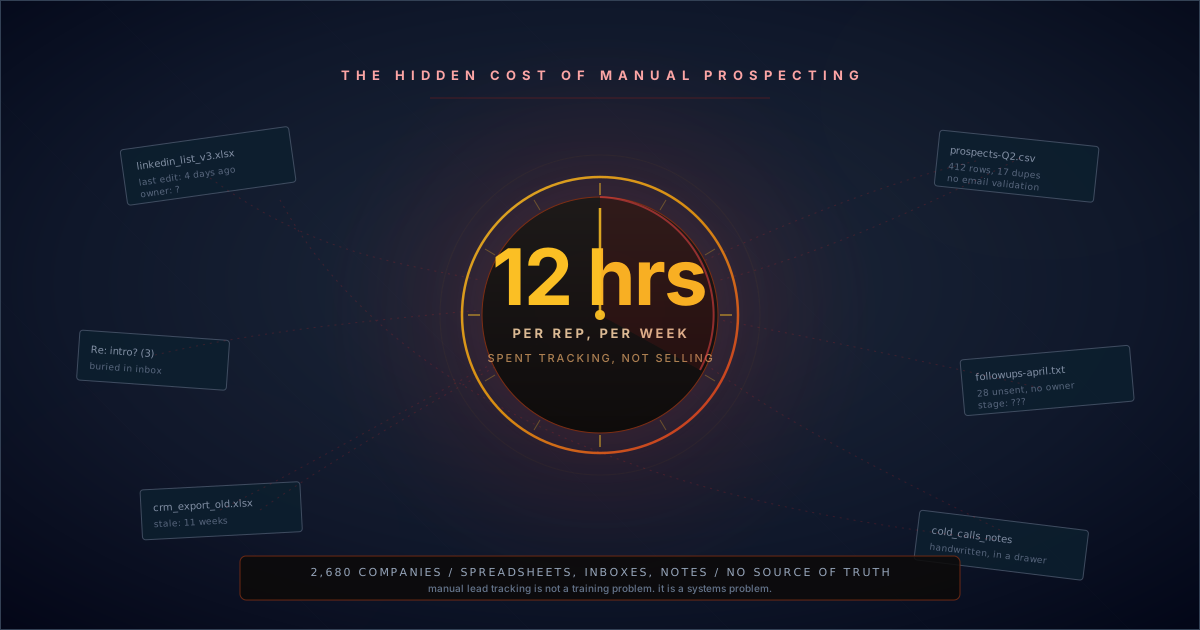
Walk into most mid-market sales operations and the same scene plays out. A rep has a LinkedIn tab open, a spreadsheet next to it, and an inbox underneath. They copy a name. They guess at an email. They paste it into a list. Two hours later they have made three actual calls.
This is not a training problem. It is a systems problem. And it shows up across the pipeline as a single recurring pain signal: manual prospecting. We see it in 2,680 companies in our current dataset. The pattern is consistent enough that the cost is now predictable.
The Hidden Cost of Manual Lead Tracking
The most obvious cost is time. The average sales rep we look at spends roughly 12 hours per week on manual lead tracking, list building, and data hygiene. For a team of ten, that is 6,000 hours a year of administrative work charged to a sales budget. Even at a modest fully-loaded rep cost, the math gets uncomfortable quickly.
The less obvious cost is what gets crowded out. Reps who spend the morning on spreadsheets do not get to the phone until after lunch. Follow-up windows close. Warm leads cool. Conversion rates drop, but in a way that never appears as a single line item, so nobody fixes it.
The third cost is the one nobody talks about: visibility. When tracking lives in private spreadsheets and personal inboxes, leadership cannot see what is actually happening in the pipeline. Forecasts get worse. Coaching gets harder. A rep leaving the company takes their tracking with them.
Where It Actually Hurts, By Industry
The shape of the problem changes by industry, but the underlying mechanic is the same: the system of record is wherever the rep happens to keep it.
Property Management
Leasing agents handle prospect follow-up across email, phone, and property tour notes with no shared view of who has been contacted, when, or what was said. When a prospect calls about a different unit and reaches a different agent, the conversation starts over. Duplicated effort, missed follow-ups, no accountability.
Trucking and Logistics
Carrier-side BDRs cold call, email, and chase capacity across multiple channels. Tracking lives in a shared sheet that is never current, plus whatever each rep keeps locally. The result is the same lead getting touched three times by three different reps, and a different lead getting touched zero times.
Financial Services and Insurance
These teams usually do have a CRM. The CRM is just not where the work happens. Real tracking lives in inbox folders and personal spreadsheets, and the CRM gets back-filled at the end of the week, badly. Visibility looks good in the dashboard and is poor in reality.
A Path To Centralized Lead Flow Without Ripping Out Your Tools
The fix is not buying a new CRM. The fix is connecting the tools you already have so the system of record updates itself.
Step 1: Map where leads actually enter. Web forms, inbound email, LinkedIn, referrals, lists. Write them down. Most teams find five to eight sources, several of which nobody owns.
Step 2: Map where leads actually live. Not where they should live. Where they actually live. This is the spreadsheet-and-inbox audit. The gap between this and Step 1 is where the work is leaking.
Step 3: Pick one source of truth. It does not have to be your CRM. It has to be one place. Everything else feeds into it.
Step 4: Automate the feeding. New form submission writes to the source of truth. Inbound email creates or updates a record. LinkedIn touches log automatically. The rep stops typing and starts selling.
Step 5: Make it observable. A weekly view leadership can read in five minutes. Stages, owners, dates, last touch. If you cannot answer "what is in the pipeline" in one query, the system is not done yet.
This is not a six-month project. The first version of this for most teams is two to four weeks, and the lift shows up in the next reporting cycle.
Frequently Asked Questions
Do I need to replace my CRM?
No. Most of the lift comes from connecting what you already have. Replacing the CRM is a much bigger project with much higher risk, and it does not solve the underlying tracking problem on its own.
How long does it take to set up centralized lead tracking?
For a typical mid-market team, two to four weeks to get a working version, then ongoing tuning. The biggest variable is how many lead sources you have and how clean your existing data is.
Can I track leads from multiple channels in one place?
Yes, and you should. Web, email, LinkedIn, referrals, lists, and inbound calls can all feed the same record. The point of centralization is that the rep does not care which channel a lead came through, and neither does leadership.
What if I do not have a CRM at all?
You do not need one to start. A well-structured shared workspace plus automated intake gets you most of the way. You can add a CRM later if and when you need the additional functionality, and the migration will be cleaner because your data is already in one place.
Related Reading
- Why Your Accounting Month-End Close Still Takes A Week — Month-end close doesn't have to be manual chaos. See why mid-market accounting teams stay stuck and what actually fixes it.
- Why Your Trucking Dispatch Still Uses Paper (And How to Fix It) — Carrier data fragmentation costs trucking operations thousands monthly. Here's how to consolidate dispatch, accounting, and carrier comms in one workflow.
- Why Your CRM Sits Empty While Operations Burn — 4,373 mid-market companies have no CRM. Here's what that costs you in dispatch delays, lost follow-ups, and margin leakage.
Related Solutions
- Workflow Automation — Connect the tools your team already runs.
Related Solutions
Want to put this into practice?
Book a 30-minute call. We'll talk through how this applies to your business and where the biggest opportunities are.
Book a Discovery CallRelated Insights
Workflow Design
Why Your Accounting Month-End Close Still Takes a Week
Month-end close doesn't have to be manual chaos. See why mid-market accounting teams stay stuck and what actually fixes it.
Read insightTrucking
Why Your Trucking Dispatch Still Uses Paper (and How to Fix It)
Carrier data fragmentation costs trucking operations thousands monthly. Here's how to consolidate dispatch, accounting, and carrier comms in one workflow.
Read insightProperty Management
Why Your CRM Sits Empty While Operations Burn
4,373 mid-market companies have no CRM. Here's what that costs you in dispatch delays, lost follow-ups, and margin leakage.
Read insight