How Are You Using AI to Grow Revenue? the Board Question
Every board is now asking how AI is growing the top line, not just cutting costs. Most answers are weak. The right answer is a system, not a pilot or tool.

Alex Schreiner
Head of Growth
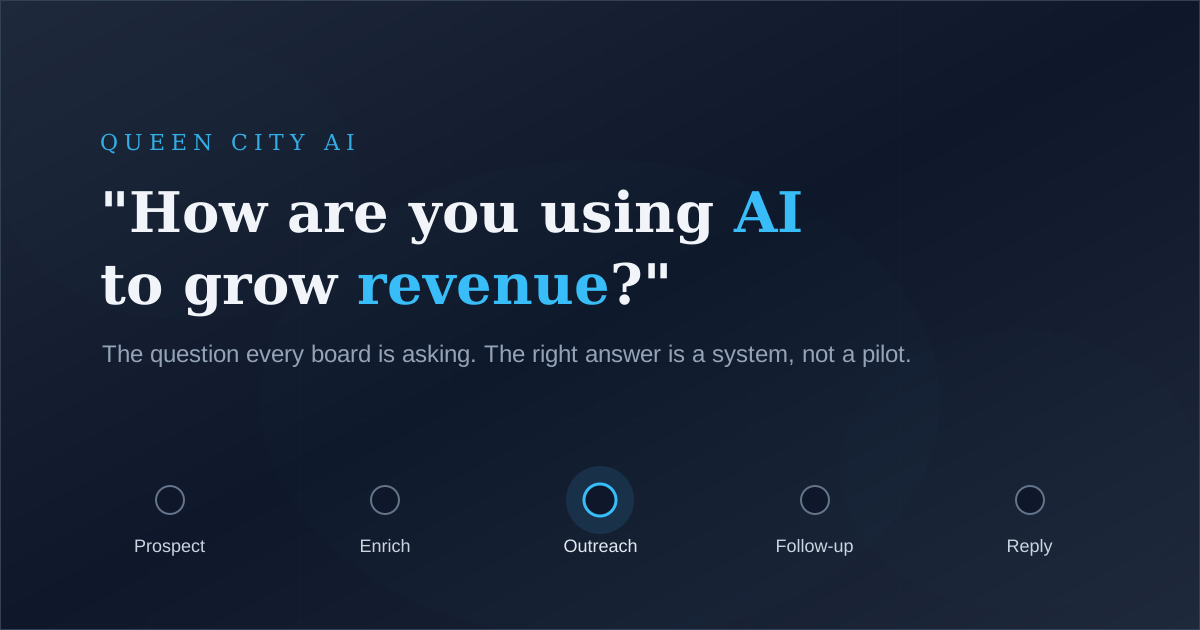
There is one question moving to the top of every board agenda right now. It gets asked in different words, but it always lands the same way: "How are you using AI to grow revenue?"
Not how you are using AI to cut headcount. Not how you are piloting a chatbot in support. How it is growing the top line. And in most rooms, the leadership team does not have a clean answer.
Why the board is suddenly asking
A year ago, "we are exploring AI" was an acceptable answer. It is not anymore. Three things changed at once.
Competitors are talking. Every earnings call, every industry conference, every peer dinner now includes someone claiming an AI-driven edge. Boards hear it and want to know where they stand.
The hype has a bill attached. Companies have spent real money on AI over the last two years, and directors want to see it on the income statement. Licenses, pilots, and internal tooling show up as cost. The board wants to know what showed up as revenue.
And the easy wins are spoken for. Most organizations have already pointed AI at support tickets, document summarization, and internal productivity. Those are real, but they are cost-side. They make the company a little leaner. They do not make it grow. The board has noticed the difference.
Why most answers are weak
When a CEO turns to the leadership team, the honest answer is usually some version of: we have bolted AI onto the things that were already easy to automate.
That is the gap. Companies have treated AI as an efficiency project, not a growth project. The work went into the back office and the support queue because that is where the friction was most visible and the risk felt lowest. Almost nobody pointed AI at the top of the funnel, where revenue actually starts.
It is an understandable choice and a losing one. You cannot answer a revenue question with an efficiency story. "We reduced ticket handling time by 18 percent" is a fine sentence, but it is not the sentence the board asked for. The companies that will have a real answer next year are the ones building an AI motion aimed squarely at pipeline and revenue, not just at cost.
What an AI revenue motion actually looks like
Here is the part most leadership teams have not internalized: the highest-volume, most repeatable, most under-resourced work in any company is the top of the sales funnel. Finding the right accounts. Researching what they care about. Writing the first personalized message. Following up four times when the first three get no reply. Routing the responses that come back.
That work is unglamorous, it scales linearly with headcount, and it is exactly the kind of work machines are now good at. This is the case for an AI Growth Engine: an operator-led, always-on revenue motion that runs the prospecting, enrichment, personalized outreach, follow-up, and reply handling at machine scale, while a human owns the strategy and the relationships.
That last part is the whole point. We are not describing a tool you hand to your reps. We are describing a system that does the SDR work end to end, every day, so the humans on your team spend their time on the conversations that close revenue instead of the data entry that precedes them. You can see the seven-agent version of this running on our own interactive demo. It is the same architecture we run on our own outbound, which is the only kind of AI we are willing to sell.
Why the ROI almost always pencils out
This is where the conversation gets concrete, so let us do the math. The figures below are illustrative and modeled, not a specific client result. Use them as a framework, then plug in your own numbers.
A fully-loaded sales development rep in the US runs roughly $70,000 to $100,000 per year once you add base, commission, benefits, tools, and management overhead (a commonly cited industry range, not a QCAI measurement). On top of that you carry the cost of ramp time before they are productive, and the cost of churn when they leave, which SDR teams do at a high rate.
Set that against the AI Growth Engine's Fully Managed tier at $2,500 per month, or $30,000 per year. The system does not ramp, does not take PTO, and does not resign. It runs the same motion every weekday.
Now frame the payback the way a CFO would, in opportunities rather than promises. At $30,000 per year, the engine has to produce only a handful of qualified opportunities to cover its own cost, and far fewer than that to beat the marginal economics of an additional human rep. If your average closed deal is worth, say, $25,000, a single won deal that the engine sourced pays for more than a year of the system. The exact breakeven depends on your deal size, win rate, and sales cycle, which is why we model it with your numbers before anyone signs anything. But the structure of the math is what makes boards comfortable: the downside is bounded and known, and the upside is tied directly to revenue.
That is the answer the board is actually looking for. Not "we are saving money on AI," but "we have a revenue system whose cost is fixed and whose output is pipeline."
An AI Growth Engine is not the same as hiring an SDR
The instinct, when a board asks about growth, is to approve another sales hire. Sometimes that is right. But a single SDR gives you one person's worth of capacity, on a ramp, with a ceiling, who can leave. An AI Growth Engine gives you a motion that runs at machine scale from day one and compounds as you tune it.
The smarter framing is not "AI instead of people." It is AI for the repeatable volume work, and people for the judgment and the relationships. The engine fills the calendar. Your closers close. That division of labor is what lets a company grow the top line without growing the org chart, which is the outcome the board wants and the one a pilot will never deliver.
The executive takeaway
When the board asks how you are using AI to grow revenue, the wrong answer is a list of pilots. Pilots are how you say "not yet" in a way that sounds like progress. The right answer is a system: an always-on revenue motion, with fixed cost and revenue-tied output, that a human operator owns and the machine runs.
That is the bar in 2026. The companies that clear it will spend next year's board meeting talking about pipeline. The ones that do not will spend it explaining another pilot.
Frequently Asked Questions
How is AI used to grow revenue, not just cut costs?
Most companies have only pointed AI at cost-side work like support, document handling, and internal productivity. To grow revenue, AI has to run the top of the sales funnel: finding the right accounts, researching them, writing personalized outreach, following up, and handling replies. An AI Growth Engine does that revenue motion end to end, every day, so the output shows up as pipeline rather than as efficiency.
What is the ROI of an AI Growth Engine or AI SDR?
The economics are straightforward to model. A fully-loaded human SDR in the US costs roughly $70,000 to $100,000 per year (a common industry range) plus ramp time and churn. The AI Growth Engine's Fully Managed tier is $2,500 per month, or $30,000 per year, with no ramp and no turnover. Framed as payback, the system only needs to source a handful of qualified opportunities, or a single won deal, to cover its annual cost. The exact breakeven depends on your deal size, win rate, and sales cycle, which we model with your numbers. These figures are illustrative, not a specific client result.
Is an AI Growth Engine better than hiring an SDR?
It depends on what you need, but they solve different problems. A single SDR gives you one person's capacity, on a ramp, with a ceiling, who can leave. An AI Growth Engine runs the repeatable volume work at machine scale from day one and does not churn. The strongest setup is usually both: the engine handles prospecting, enrichment, outreach, and follow-up, while your people own the judgment calls and the relationships that actually close deals.
Why are most companies' AI efforts not growing revenue?
Because they treated AI as an efficiency project. The early work went into the back office and the support queue, where friction was visible and risk felt low. That makes a company leaner, not larger. Growing revenue requires aiming AI at the top of the funnel, which most organizations have not done yet. That is exactly the gap boards are now pressing on.
What does Queen City AI's AI Growth Engine actually do?
It is an operator-led, always-on outbound system built from seven AI agents that handle prospecting, lead scoring, enrichment, personalized multi-touch outreach, follow-up, and reply handling for your ideal customer profile. A human owns the strategy and the relationships while the system runs the SDR work at machine scale. It is the same architecture we run on our own outbound, and you can try the interactive demo to see it in action.
How quickly can an AI revenue motion be live?
The AI Growth Engine is configured around your ideal customer profile and your messaging, then runs every weekday. Because it is a managed system rather than a tool your team has to learn, there is no ramp period the way there is with a new hire. The honest first step is a short conversation to model the economics against your deal size and sales cycle before anything is committed.
Related Solutions
Want to put this into practice?
Book a 30-minute call. We'll talk through how this applies to your business and where the biggest opportunities are.
Book a Discovery CallRelated Insights
Agentic AI
Build 2026 Made Safe AI Agents an OS Feature. We Were Already Running Them in Production.
Microsoft made agent containment a built-in Windows primitive at Build 2026. We had already deployed contained, enterprise-grade AI agents in production.
Read insightStrategy
How Do You Actually Choose an AI Consultant? a Buyer's Checklist
A founder-to-buyer checklist for choosing an AI consultant: the questions to ask before you sign, how to spot real results over hype, and avoiding lock-in.
Read insightThought Leadership
Businesses Don't Need Another AI Tool. They Need a Better Way to Work.
Most companies do not need a sweeping AI strategy to begin. They need one workflow that gets better. Here is how to find it, and where Claude actually fits.
Read insight