How Do You Actually Choose an AI Consultant? a Buyer's Checklist
A founder-to-buyer checklist for choosing an AI consultant: the questions to ask before you sign, how to spot real results over hype, and avoiding lock-in.
Justin Hinote
Partner & AI Business Consultant
Most of the AI consultant pitches you will sit through sound the same. Everyone has a slide about transformation, a logo wall, and a demo that works perfectly because it was built to work for that demo. None of that tells you whether the work will hold up inside your business on a Tuesday in six months.
We run an AI consultancy, so this is self-interested advice. But it is also the advice we would give a friend who was about to sign with someone else. Here is what we would tell you to ask us, and what your answers should sound like.
Start with the work, not the technology
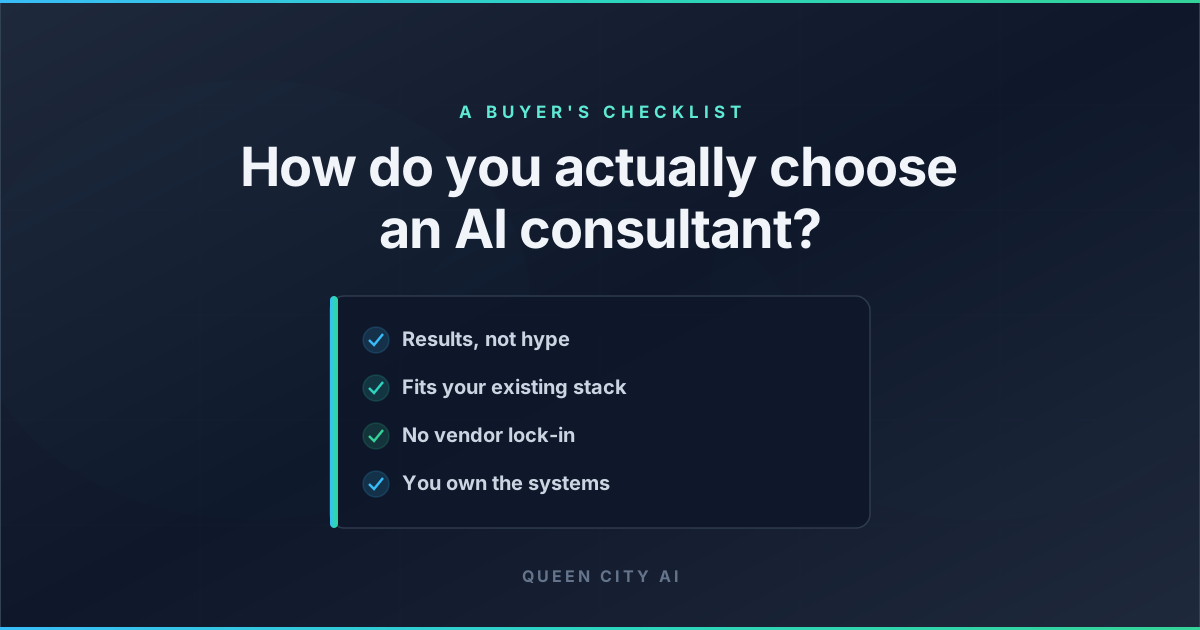
The first question is not "what models do you use" or "are you agentic." It is "what specific task in my business will be different after this engagement, and how will we both know it worked." A consultant who can answer that in plain language is thinking about your operations. One who answers with a tour of their tooling is thinking about their pitch.
Good AI work starts from a real bottleneck. Someone is rekeying data between two systems. A close takes nine days because three people pass a spreadsheet around. Intake leaks because nobody owns the handoff. The consultant's job is to find that, measure it, and design the smallest thing that removes it. If nobody on the other side of the table wants to spend time understanding how your business actually runs before proposing a build, that is the answer to your question.
This is why we run a discovery session before we build anything. Not as a sales formality, but because you cannot automate a workflow you have not mapped, and you should not pay anyone who is willing to skip that step.
Make them prove it, not promise it
A demo proves the consultant can build something. It does not prove the something solves your problem. The gap between those two is where most AI projects quietly die.
Ask for a pilot scoped to one real workflow, run against your real data, with a number attached. Hours saved, error rate dropped, days off the cycle time. If the proposal is a six-figure platform with the payoff somewhere past month nine, slow down. The firms worth hiring are comfortable being measured early, because they would rather prove value than promise it. The ones who resist a small, measurable first step are usually protecting a margin, not your outcome.
Watch who owns what at the end
The most expensive mistake in AI consulting is not a failed project. It is a successful one you can never leave. The system works, it saves real time, and the only people who understand it, host it, or can change it are the consultants who built it. Now their renewal is non-negotiable and their rate only goes one direction.
Before you sign, get clear answers on three things: who owns the code and the configuration, where it runs, and what happens to all of it if you part ways. The right answer is that you own the systems, they live in your accounts, and you could hand them to another team tomorrow. We build it that way on purpose. A consultant who is good at the work does not need lock-in to keep the relationship, and one who relies on lock-in is telling you something about the work.
Pressure-test the fit with your actual stack
AI does not run in a vacuum. It plugs into the CRM, the accounting system, the dispatch board, the inbox, and the spreadsheets your team actually lives in. A consultant who has never asked what you run, or who wants to replace your stack with their preferred platform as step one, is solving for their convenience.
Ask them to walk through how the work connects to two or three of your existing systems specifically. The good ones get concrete fast, because they have done the integration work before and know where it gets hard. This is also a good moment to bring in whoever actually maintains your systems and let them ask the awkward questions. If the consultant gets vague or annoyed when a practitioner pushes, you have learned something useful before you spent a dollar.
The short version
The pattern across all of this is simple. Hire the firm that wants to understand your business before it sells you technology, that is willing to be measured early, that leaves you owning everything, and that fits the way you already work. If you want a structured way to think about scope and sequencing before you talk to anyone, our AI game plan is built around exactly these questions.
Frequently Asked Questions
What should I look for in an AI consultant?
Look for a consultant who starts with your business, not their technology. The strongest signal is that they want to understand a specific bottleneck in your operations and attach a measurable outcome to fixing it before they propose a build. Be cautious of pitches that lead with model names, logo walls, or polished demos that were built to impress rather than to solve your actual problem. You want someone who maps the workflow first, scopes the smallest thing that removes the friction, and is comfortable being measured early.
Should I hire a boutique AI shop or a big consulting firm?
It depends on what you are buying. A large firm gives you brand assurance, deep bench, and process, but you often get junior staff doing the work, slow timelines, and a platform-first approach that may not fit a smaller operation. A boutique shop gives you direct access to the people who actually build, faster iteration, and work scoped to your real workflows, at the cost of a smaller team. For most small and mid-market businesses, the boutique model wins because the work is operational and hands-on, not a multi-year transformation program. Ask either one who specifically will be doing the work, and whether you will talk to them or to an account manager.
How do I tell real AI results from hype?
Ask for proof, not promises. Real results come with a number attached to a specific workflow: hours saved per week, error rate reduced, days cut from a cycle time, all measured against your own data in a scoped pilot. Hype sounds like transformation, intelligence, and revolution with the payoff always somewhere past month nine. A consultant confident in the work will propose a small, measurable first step and let you judge it. One who resists early measurement is usually protecting a margin rather than your outcome.
How do I avoid vendor lock-in with an AI consultant?
Get clear written answers to three questions before signing: who owns the code and configuration, where the systems run, and what happens to everything if you part ways. The healthy arrangement is that you own the systems, they live in your own accounts and infrastructure, and another team could take them over tomorrow. Lock-in shows up as proprietary platforms you cannot export, hosting only the consultant controls, or undocumented systems only they understand. A consultant who is genuinely good at the work does not need lock-in to keep your business.
Will an AI consultant actually fit my existing tech stack?
A good one will, and you should make them prove it before you sign. AI work has to plug into the CRM, accounting, dispatch, inbox, and spreadsheets your team already uses. Ask the consultant to walk through, concretely, how the proposed work connects to two or three of your existing systems. The experienced ones get specific quickly because they have done the integration work and know where it gets difficult. Bring in whoever maintains your systems and let them ask hard questions. If the consultant wants to replace your stack as step one, they are solving for their convenience, not yours.
How long should a first AI engagement take?
Shorter than most pitches suggest. A well-scoped first engagement targets one real workflow and shows a measurable result in weeks, not quarters. That early proof point tells you whether the consultant understands your business and whether the approach works, before you commit to anything larger. Engagements that backload all the value past month nine carry far more risk and give you no cheap way to walk away if the fit is wrong.
Related Solutions
Want to put this into practice?
Book a 30-minute call. We'll talk through how this applies to your business and where the biggest opportunities are.
Book a Discovery CallRelated Insights
Growth
Mid-Market Revenue Growth Doesn't Need More Volume. It Needs a System That Compounds.
Mid-market growth teams do not need more outbound volume. They need an AI system that compounds research, personalization, and follow-up — with humans on send.
Read insightWorkflow Design
Using Claude for Workflow Integrations: Beyond the Chat Window
The leverage in 2026 isn't whether your team uses Claude. It's whether Claude is integrated into the workflows themselves, where the work actually moves.
Read insightThought Leadership
Businesses Don't Need Another AI Tool. They Need a Better Way to Work.
Most companies do not need a sweeping AI strategy to begin. They need one workflow that gets better. Here is how to find it, and where Claude actually fits.
Read insight